The Franciscan Monastery of Dubrovnik
The Franciscan Monastery of Dubrovnik
Founded in 1317 at the start of Stradun, the Franciscan Monastery of Dubrovnik combines a late Romanesque cloister, an ancient library and a pharmacy that has been in operation for seven centuries.
The Franciscan Monastery holds a central place in the old town of Dubrovnik, just steps from the Pile Gate. Founded in 1317, it houses a late Romanesque cloister of 120 columns, an ancient library and Europe's third oldest pharmacy, still in operation.
Why visit the Franciscan Monastery
The site combines multiple interests within a single building: medieval architecture spared by the 1667 earthquake, a heritage garden maintained for seven centuries, a substantial collection of historic materials and a pharmacy in continuous operation since its foundation. It is one of the rare religious complexes in Dubrovnik to have preserved a significant part of its original structure.
A visit remains manageable (plan 30 to 45 minutes) and fits easily into a tour of the old town, as the monastery sits at the beginning of Stradun. Entry is affordably priced, with reduced rates for students and children.
History of the monastery
Construction of the monastery and its church began in 1317. The complex has never been relocated since its founding, contrary to a sometimes widespread belief that places it initially to the west of the city. Most of the work was completed during the 14th century.
The 1667 earthquake devastated Dubrovnik and severely damaged the monastery. Of the original building, only the Gothic portal of the church survived. A work by the Andrijić brothers, local stonemasons, this portal dates from 1498 and remains one of the most complete medieval elements visible in the city today.
The library was arranged in the 17th century by Vital Andrijašević, a Croatian philosopher and theologian. The fire following the earthquake destroyed 7,500 books and manuscripts, which the monks subsequently reconstructed through patient restoration and acquisition.
What to see on site
The main cloister
Built in 1360 by Mihoje Brajkov of Bar, the main cloister contains 120 twin columns. The capitals, sculpted with floral motifs, human heads and animals, are characteristic of late Romanesque, while the slender proportions of the shafts reflect Gothic influence. The barrel vaults of the galleries bear murals, including a depiction of Dubrovnik prior to the 1667 earthquake.
At its centre lies the cloister garden, considered Dubrovnik's oldest. It is organised around a Gothic well topped with a statue of Saint Francis, surrounded by orange trees and palms.
The church
The present church is in Baroque style, a direct consequence of post-1667 reconstruction. The Gothic-Renaissance portal of the Andrijić brothers, the only survivor of the medieval edifice, constitutes its most remarkable feature. The acoustics of the space enable it to host, in July, several musical performances of the Dubrovnik Summer Festival.
The library
The library today preserves several tens of thousands of volumes, including approximately 500 manuscripts, 137 incunabula and 7 old chorale books. To these are added paintings by old masters and pieces of liturgical goldwork and silverware. Access to the collection is restricted to researchers, but a selection is presented to visitors.
The pharmacy
In operation since 1317, the pharmacy is Europe's third oldest. Until 1901, it occupied a small cloister to the north of the great cloister; it was subsequently moved to the left of the current entrance. The historic section can be visited, while the modern dispensary offers herbal preparations inspired by monastic recipes.
Practical information
- Recommended visit duration: 30 to 45 minutes.
- Moderate admission fee, with reduced tickets for students and children. Check current prices at the entrance, as Croatie switched to the euro in 2023.
- Wider hours in high season (April to October) and reduced in winter. Closure is generally advanced to early afternoon from November to March.
- Proper attire required, as the church remains an active place of worship.
When to visit
The monastery is open year-round. The most comfortable period extends from April to June and September to October: mild temperatures, favourable light on the cloister columns and fewer visitors than in peak summer. In July and August, the old town is crowded with cruise passengers; it is best to arrive early morning. July nevertheless offers particular appeal with Summer Festival concerts in the church.
How to get there
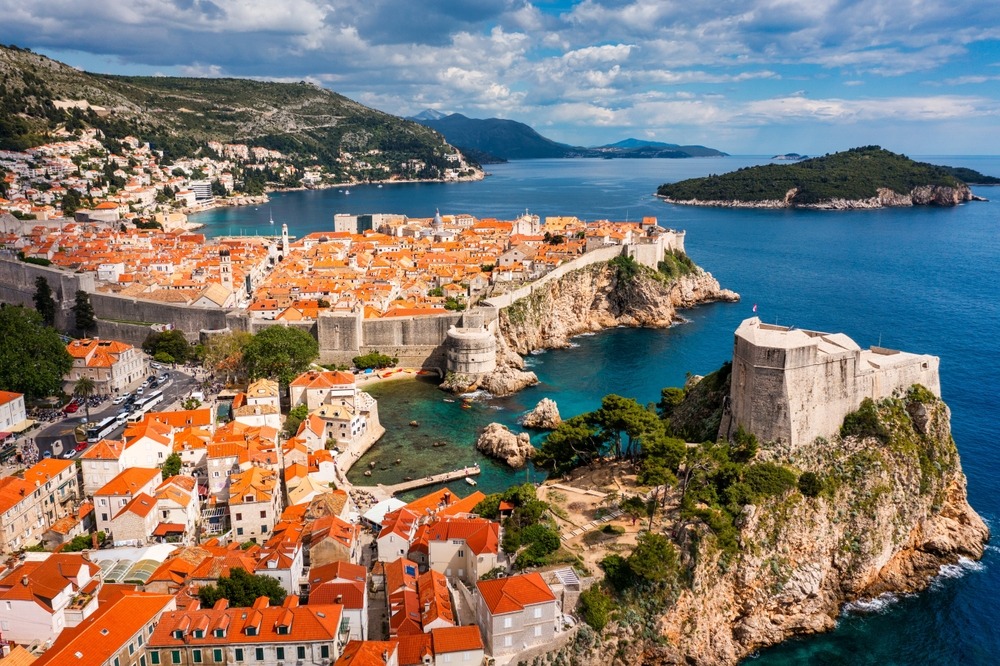
The main entrance is located approximately 2 minutes' walk from the Pile Gate, near the great fountain of Onofrio, at the very beginning of Stradun. As the old town is pedestrian-only, access is on foot from one of the three historic gates.
By public transport, buses 1A and 1B serve the Pile Gate stop, about 150 metres from the entrance. By car, the Pile public car park remains the most practical option, approximately 5 minutes' walk away. Taxis drop off directly in front of the Pile Gate.
Nearby attractions
- Dubrovnik: the fortified old town, Stradun and the city walls.
- The walls of Ston: approximately 1 hour by car, one of Europe's longest fortifications.
- Diocletian's Palace in Split: a major stop if you continue up the Dalmatian coast.
- Zlatni Rat beach on the island of Brač: accessible from Split by ferry.
Frequently asked questions
Frequently asked questions
Allow 30 to 45 minutes to walk through the cloister, church, library and historic part of the pharmacy. Plan for longer if you attend a Summer Festival concert.
Yes. Founded in 1317, it is Europe's third oldest pharmacy still in operation. A modern dispensary, located to the left of the entrance since 1901, sells herbal preparations.
As the church is active, visitor access may be restricted during services. The cloister and library remain accessible during normal hours. Proper attire is requested.
Opening in early morning, before cruise groups arrive, or late afternoon in the shoulder season. April, May, September and October offer the most pleasant conditions.
The entrance from Stradun is at ground level, and the main cloister is accessible. Some areas (library, upper floors) feature historic staircases without specific adaptations.
Prepare your trip
The Franciscan Monastery fits naturally into a broader Dalmatian itinerary, between Dubrovnik, Ston and Split. To build a tailor-made trip incorporating these stages, consult our trips to Croatie.
Interested in this visit?
We can include it in your personalised itinerary.