Ston Walls
Ston Walls
Spanning 5.5 km, the Ston Walls link Ston to Mali Ston in Croatie. History, walking route, salt pans, oysters and visiting advice.
With its 5.5 km of continuous ramparts linking Ston and Mali Ston on the Pelješac peninsula, the Ston Walls are often presented as the longest standing defensive fortification in Europe. Nicknamed the "European Great Wall of Chine", they attracted over 70,000 visitors in 2023 and combine medieval military heritage with a rare setting: active salt pans and oyster beds.
Why visit the Ston Walls
The site's appeal lies in several rarely combined elements. You walk along a 14th-century defensive structure preserved over an exceptional length, in a landscape of karst hills overlooking salt marshes. The hike along the ramparts offers sweeping views over Mali Ston Bay and Dalmatian ridges. The site is also recognized by Game of Thrones enthusiasts, who spot sets used to represent the walls of King's Landing.
A visit pairs easily with oyster tasting in Mali Ston and crossing the Pelješac peninsula, renowned for its red wines.
History of the walls
Construction of the walls began in 1333, shortly after the Republic of Ragusa (present-day Dubrovnik) acquired the Pelješac peninsula. The primary objective was to protect the region's salt pans, a strategic resource that contributed significantly to the city-state's revenues. The fortification also served as an advanced defensive line for Ragusa.
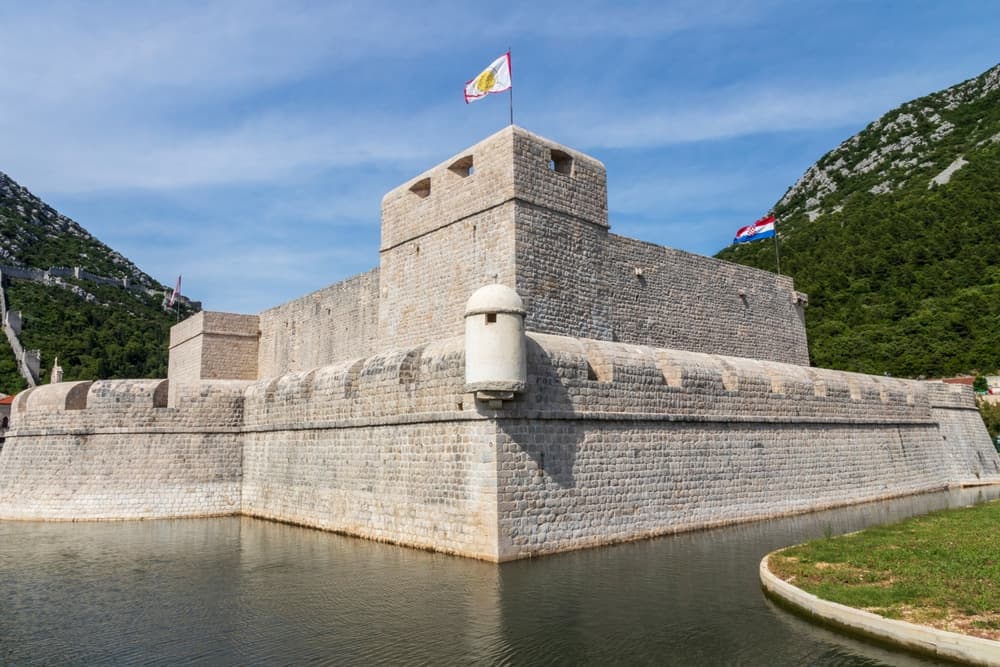
The structure originally stretched approximately 7 km and connected the villages of Ston and Mali Ston. It comprised 40 towers and 5 fortresses, including Veliki Kaštio, built in 1357. The walls rise between 5 and 10 metres in height depending on sections.
In the 19th century, Austrian authorities partially demolished the walls to recover materials for construction of schools, public buildings, and a triumphal arch erected for the visit of Emperor Francis Joseph I. Demolitions continued after World War II. The length preserved today, at 5.5 km, nonetheless remains remarkable on a European scale.
A Game of Thrones filming location
Like Dubrovnik, which served as the primary setting for King's Landing, the Ston fortifications were used to represent the walls of the fictional capital in several scenes from the series. This association helped raise the site's profile among international audiences.
What you'll encounter on site
The rampart path crosses watchtowers, bastions and stone forts. The route features numerous stairs with uneven steps, and good fitness is recommended to complete it in full. You can also limit yourself to the section encircling Ston, which is shorter and more accessible.
Beyond the military architecture, two historic town centres merit a stop:
- Ston: on the central square, a 15th-century episcopal palace and a Romanesque church survive from the medieval core. The salt pans, still active, are open to visitors and illustrate the wall's historical purpose.
- Mali Ston: this small port preserves the bay's oyster farming tradition. Waterfront restaurants offer fresh oyster tastings, often paired with mussels and local wine.
Practical information
Two entrances provide access to the ramparts: the Arcimun bastion on the Ston side and Koruna fortress on the Mali Ston side. You can begin from either depending on your arrival point.
- Entrance fee: moderate, adjusted by age, season and group size. Verify current pricing on site or the official website before your visit.
- Opening hours: extended from April to October, more limited in winter. Check the day's hours before arriving.
- Duration: allow 1 to 2 hours for the full route, less for the Ston loop alone.
- Equipment: closed-toe shoes, plenty of water, hat and sunscreen. The path offers no shade.
When to visit
A visit is possible year-round. Spring (April-May) and early autumn (September-October) offer the best conditions: manageable temperatures on the unshaded ramparts, favourable light for panoramic views. In July and August, midday heat can be intense; prefer early morning or late afternoon visits. Winter allows for a peaceful experience, though opening hours are reduced.
How to get there
Ston sits at the entrance to the Pelješac peninsula, approximately one hour's drive north-west of Dubrovnik. Car remains the most practical means of access: the coastal D8 road then the branch towards Pelješac lead directly to the village. Coach services also connect Dubrovnik to Ston several times daily in season.
From Split, allow approximately three hours by road via the Pelješac Bridge, opened in 2022, which bypasses passage through Bosnian territory. Ston can also feature in an itinerary linking Dubrovnik to Korčula island, accessible by ferry from Orebić at the peninsula's far end.
Nearby attractions
The region offers several natural extensions to your visit:
- Pelješac peninsula: Dingač and Postup vineyards, Trstenik and Žuljana beaches, Orebić village facing Korčula.
- Dubrovnik: the mother city of the Republic of Ragusa, one hour to the south, with its own UNESCO-listed ramparts.
- Korčula: neighbouring island accessible by ferry, whose fortified old town is sometimes called the "little Dubrovnik".
Other Croatie heritage sites complete a cultural itinerary, notably Diocletian's Palace in Split and the Museum of Broken Relationships in Zagreb. For a beach break, Zlatni Rat beach on Brač island is among the country's most famous.
Frequently asked questions
Frequently asked questions
Allow 1 to 2 hours to walk the full 5.5 km between Ston and Mali Ston. The loop around Ston alone takes about 45 minutes. Add time to explore the villages, salt pans and enjoy oyster tasting in Mali Ston.
The section encircling Ston is the shortest and most accessible. It allows you to see Veliki Kaštio and already offers good views over the salt pans. The climb towards the heights between Ston and Mali Ston is more demanding but offers the broadest panoramas.
The route features numerous stairs with uneven steps and is not wheelchair accessible. With young children, it's better to stick to the lower section around Ston and a walk through the two villages.
Yes, the site is open year-round with extended hours in summer season and more limited hours in winter. Spring and autumn offer the best visiting conditions.
Allow approximately one hour by car via the D8. Coaches also operate the route several times daily, particularly in high season.
Include Ston in your itinerary
The Ston Walls fit naturally into a southern Dalmatie circuit, between Dubrovnik, the Pelješac peninsula and the islands of Korčula or Mljet. To build a coherent journey and make the most of Croatie's heritage and landscapes, consult our itinerary suggestions on the Croatie dedicated page.
Interested in this visit?
We can include it in your personalised itinerary.