The Euphrasian Basilica of Poreč
The Euphrasian Basilica of Poreč
A sixth-century religious complex inscribed on the UNESCO World Heritage list, the Euphrasian Basilica of Poreč preserves Byzantine mosaics among the best preserved in the Mediterranean.
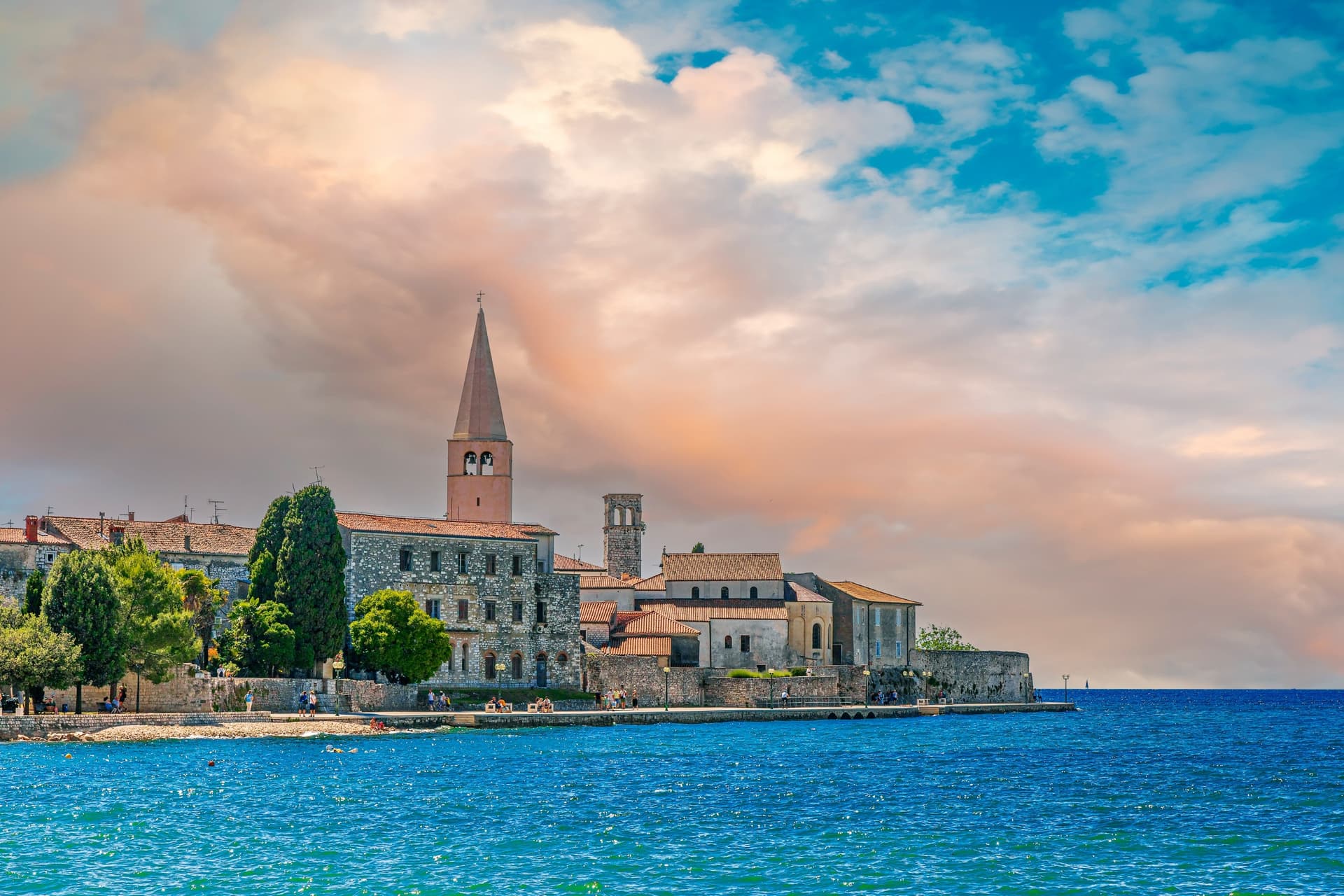
Located in the historic center of Poreč in Istria, the Euphrasian Basilica forms a remarkable Early Christian religious complex distinguished by its outstanding state of preservation. Its sixth-century Byzantine mosaics, nearly intact, earned it inscription on the UNESCO World Heritage list in 1997.
Why visit the Euphrasian Basilica
The complex ranks among the best-preserved examples of Early Byzantine architecture in the Mediterranean. The ensemble unites the basilica itself, an atrium, an octagonal baptistry, an episcopal palace, and a bell tower, forming a cohesive testimony to sixth-century religious art. The mosaics of the apse, executed by Byzantine craftsmen, count among the most complete of this period in Europe.
Beyond its artistic significance, the site documents over fifteen centuries of continuous Christian occupation, from a fourth-century Roman villa to fifteenth-century Gothic restorations.
History of the complex
The first basilica was built atop the ruins of a fourth-century Roman villa and dedicated to Saint Maurus of Parentium, patron of the city. This oratory was later enlarged into a basilicae geminae-type church, featuring a nave and side aisle. The floor mosaic, adorned with a fish—a Christian symbol predating the cross—dates to this period.
The present edifice, dedicated this time to Mary, was commissioned by Bishop Euphrasius to replace the ruined basilica. Work began in 553 and lasted a decade. The builders reused materials from the old building and imported marble blocks from the shores of the Sea of Marmara. The wall mosaics were entrusted to Byzantine craftsmen, while the floor mosaics reflect the work of local workshops.
In 1440, an earthquake damaged the south wall of the central nave. During restoration, the destroyed windows were replaced with Gothic-style openings, still visible today. The bell tower, erected in 1522, stands 35 meters high. The 1997 UNESCO inscription consecrated the exceptional value of the ensemble.
What to see on site
The atrium
The visit begins with a square courtyard bordered by columns imported from Istanbul. A marked pathway then guides you through the various parts of the complex.
The baptistry
An octagonal edifice from the fifth century, the baptistry houses a hexagonal baptismal pool at its center. Its spare interior hints at richer decorations that have since disappeared.
The bell tower
Built in 1522 and standing 35 meters tall, it is open to visitors. A few narrow steps lead to a summit offering sweeping views over the rooftops of the old town and the Istrian coast.
The episcopal palace
This imposing waterfront building, once dedicated to receiving the bishop's guests, now houses a museum. The ground floor displays original mosaics from the fourth and fifth centuries, an altar housing the relics of Saints Mavro and Eleutherius, and a stone throne from the early ninth century.
The outdoor space
Behind the complex lies an expansive mosaic from the original Roman villa, less protected but illuminating the site's ancient occupation.
The basilica and its mosaics
The basilica entrance features Christ holding an open book inscribed with Ego sum Lux vera (I am the true light), surrounded by the twelve apostles identifiable by their respective emblems.
The apse vault concentrates the most celebrated ensemble: the Virgin Mary seated on a heavenly throne, the Christ Child in her arms, while a divine hand emerging from the clouds presents her with a crown. On either side stand two angels, followed by religious figures—Bishop Euphrasius presenting a model of the basilica, Saint Maurus of Parentium, and the archdeacon Claude. A child depicted beside them is identified by the inscription EVFRASIVS FIL ARC (Euphrasius, son of the archdeacon).
The apse walls depict scenes of the Annunciation and Visitation. The choir houses a marble ciborium built in 1277, supported by four columns; its canopy retains original mosaics. The basilica also preserves a polyptych by Antonio Vivarini and a Last Supper attributed to Palma the Younger.
Practical information
The complex is located at 22 Eufrazijeva Street (Eufrazijeva ul. 22), in Poreč's pedestrian historic center. Several parking areas lie a few minutes' walk away. Opening hours are extended in high season and reduced in winter; the entrance fee remains moderate and varies depending on whether you visit the basilica alone or the entire complex (including bell tower and museum). Guided tours are available in several languages.
Allow approximately 1 to 1.5 hours to explore the entire site, longer if you climb the bell tower. Clothing covering the shoulders is recommended when entering the basilica during services.
When to visit
Istria enjoys a temperate Mediterranean climate. Late spring (May-June) and early autumn (September) offer the most pleasant conditions: mild temperatures, favorable light for viewing mosaics, and reasonable crowds. July and August concentrate most visitors; it is best to arrive early morning or late afternoon to avoid peak crowds. In low season, hours are reduced but the visit gains in tranquility.
Nearby attractions
The old town of Poreč itself deserves a stroll: Venetian alleyways, Marafor Square (a former Roman forum), and the waterfront. To further explore Croatie, several major sites align within the same cultural itinerary, such as Diocletian's Palace in Split, the Frankopan Castle on the island of Krk, or the Blaca Hermitage on the island of Brač. On the nature side, Zlatni Rat Beach in Bol ranks among the country's most photographed coastlines.
Frequently asked questions
Frequently asked questions
Allow 1 to 1.5 hours for the atrium, baptistry, basilica, and episcopal palace. Add 20 to 30 minutes if you climb the bell tower.
Yes, the ascent of 35 meters is via an internal staircase. It is accessible to visitors in good physical condition and offers a panorama over the old town and coastline.
Several options exist depending on which areas you visit (basilica alone, or complex with museum and bell tower). Ticket details are posted at the ticket office.
The atrium and basilica are level access. However, the bell tower and certain parts of the episcopal palace require use of stairs.
The basilica remains a place of worship. Clothing covering the shoulders and knees is recommended, especially during services.
Planning your trip
The Euphrasian Basilica fits naturally into an itinerary combining Istria, Dalmatia, and Croatian islands. To build your custom stay, consult our Croatie travel suggestions.
Interested in this visit?
We can include it in your personalised itinerary.