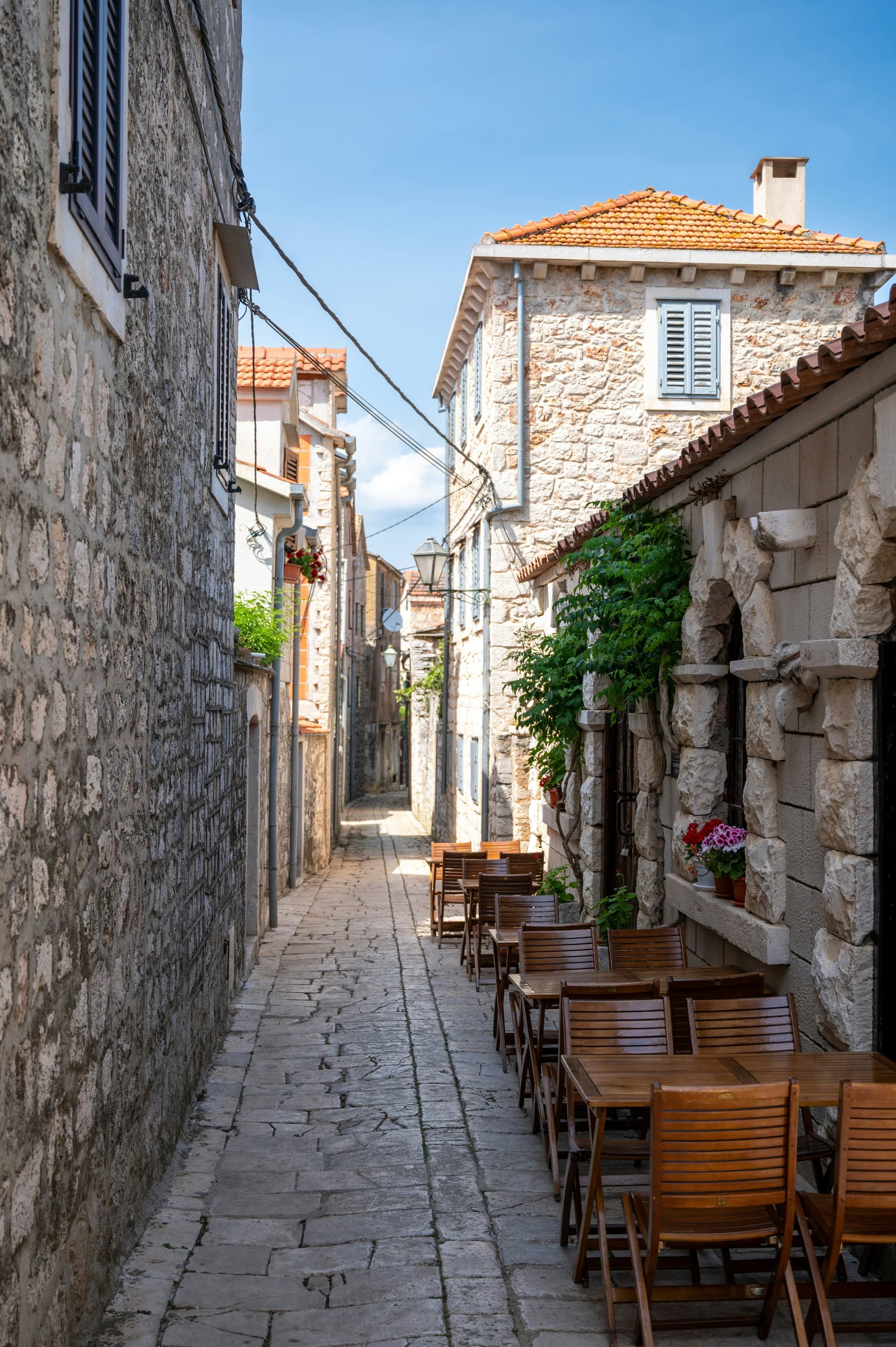
Stari Grad
Stari Grad
Founded by the Greeks in the 4th century BC, Stari Grad is Croatia's oldest city. On the island of Hvar, it blends Renaissance architecture, a UNESCO-listed agricultural plain, and an authentic atmosphere far from the summer bustle.
Stari Grad ("Old Town" in Croatian) is Croatia's oldest city, founded by the Greeks in the 4th century BC on the northern coast of the island of Hvar. Nestled at the head of a long protected bay, it offers a striking contrast to the hustle of Hvar Town: silent medieval alleyways, Renaissance palaces, and the Stari Grad Plain — UNESCO World Heritage-listed — stretching just behind the city.
Practical Information at a Glance
- Access from Split: Direct ferry Split–Stari Grad (Jadrolinija), journey approximately 2 hours; it's the main ferry port for the island of Hvar.
- Recommended duration: Half a day for the town; a full day if you explore the Stari Grad Plain.
- Dress code: Smart casual recommended for visiting churches.
- Ideal season: May–June and September–October to avoid the summer crowds.
What to See
The heart of Stari Grad is its old harbor, lined with golden stone houses. The Tvrdalj Castle, a fortified residence of Renaissance poet Petar Hektorović (16th century), houses a fish pond still filled with water — a unique architectural curiosity in the Adriatic. The Church of St. Stephen and its Dominican cloister complete the historical picture of the center.
Outside the city, the Stari Grad Plain (Starigradsko polje) preserves the original Greek agricultural layout, unchanged for 2,400 years: dry stone walls, vines, and olive trees still demarcate the ancient Greek plots.
History and Context
Founded around 384 BC by Greek colonists from Paros under the name Pharos, Stari Grad is one of the oldest Greek colonies in the Eastern Mediterranean. It passed under Roman, Byzantine, Venetian, and Austrian rule before becoming part of Yugoslavia. The agricultural plain, inscribed as a UNESCO World Heritage site in 2008, is considered the world's best-preserved example of an ancient Greek cadastre.
Highlights of Your Visit
Tvrdalj Castle
A fortified residence of Petar Hektorović, a Croatian humanist poet, built in the 16th century. The interior fish pond, fed by a seawater spring, and the enclosed garden make it a rare example of Adriatic Renaissance architecture. Latin and Croatian inscriptions adorn the walls.
The Stari Grad Plain
This UNESCO-listed cultural landscape extends over approximately 6 km² behind the city. The chora (Greek plots) are delimited by dry stone walls thousands of years old. Vines and olives are cultivated using traditional methods. A bicycle or walking tour allows you to grasp its scale.
The Dominican Cloister
Adjoining the Church of St. Stephen, this 15th-century cloister houses a small museum with Greek and Roman objects found on the island, including a well-preserved ancient mosaic.
The Old Harbor and Alleyways
Stari Grad's harbor remains intimate in scale. The alleyways leading away from it reveal discreet Venetian palaces, flower-filled inner courtyards, and an atmosphere considerably less touristy than Hvar Town.
Etiquette and Visiting Rules
- Shoulders and knees covered when entering churches and the cloister.
- Do not climb the dry stone walls of the plain — they are fragile and protected.
- The plain is a living agricultural site: respect the crops and private property.
Photography Tips
Golden morning light is ideal on the harbor and stone facades. For the plain, early morning or late afternoon reveals the dry stone walls in relief. From the heights above the city, Stari Grad Bay offers a panoramic frame with the sea and vineyards in the foreground. No known photography restrictions in public spaces.
Location and Access
Stari Grad is located on the northern coast of the island of Hvar, approximately 20 km east of Hvar Town by road. The Jadrolinija ferry from Split docks directly at Stari Grad, making it the main entry point to the island for vehicles. Local buses connect Stari Grad to Hvar Town. The town is accessible on foot from the port; the plain requires a bicycle or car.
Nearby
- Hvar Town — the island's main city, with its Spanish fortress and lively central square, approximately 20 km to the west.
- Jelsa — a quiet coastal village midway between Stari Grad and Hvar Town, with a beautiful baroque church.
- Pakleni Islands — an archipelago of small wooded islands accessible by water taxi from Hvar Town, perfect for swimming.
- Split — ferry departure point, home to the UNESCO-listed Diocletian Palace.
Frequently asked questions
The Jadrolinija ferry connects Split to Stari Grad in approximately 2 hours. It's the most direct link and the only one that accepts vehicles. Catamaran services to Hvar Town also exist, but without vehicle transport.
Tvrdalj Castle charges admission. The exact rate should be verified on-site or with the local tourism office, as it may vary by season.
May, June, and September are ideal: the weather is pleasant, the sea is swimmable, and tourist numbers remain manageable. July-August is very busy across the entire island of Hvar.
Yes, the two towns are connected by bus and road (approximately 20 km). Allow a half day for Stari Grad and a half day for Hvar Town, arriving by the morning ferry.
The plain begins just behind the city and is partially accessible on foot. To explore it fully, a bicycle or car is recommended, as it extends several kilometers.
No known photography restrictions in the plain. Simply avoid damaging the dry stone walls and do not enter private agricultural parcels.
Want to discover this destination?
Our local advisors design your tailor-made trip.