The Amphitheatre of Pula
The Amphitheatre of Pula
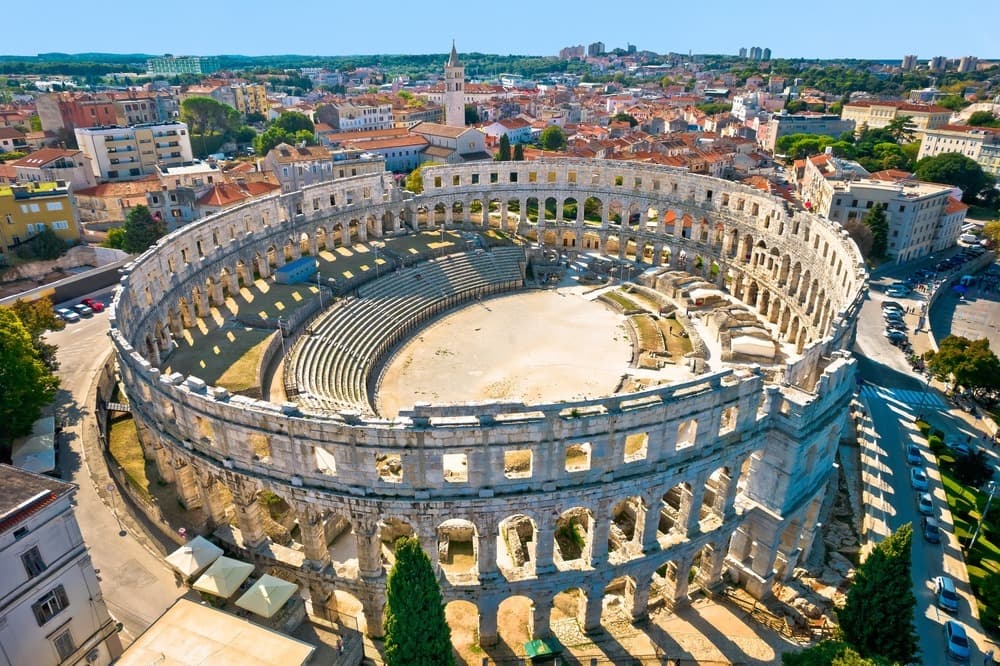
The Roman amphitheatre of Pula, one of the six best-preserved in the world, today hosts the Film Festival and major international concerts.
The amphitheatre of Pula, sometimes called the Pula Colosseum, ranks among the six largest preserved Roman amphitheatres in the world, out of some 230 recorded. Built in the 1st century, it still dominates the landscape of central Pula, in Istria, and hosts international festivals and concerts.
Why visit the amphitheatre of Pula
The Pula arena has retained the bulk of its original structure: its four corner towers, its outer walls, and nearly all of its elliptical envelope. This architectural integrity makes it a major case study for understanding Roman construction techniques, and an emblematic landmark of Croatie: the monument even appeared on 10 kuna banknotes between 1993 and 2004.
With an estimated capacity of 23,000 spectators in Roman times, the building continues to serve as a public gathering place, but for concerts, screenings and performances. Its visit thus combines archaeology, history and contemporary cultural life.
History of the amphitheatre
Construction begins under the reign of Augustus (2–14 CE) with a structure initially made of wood. Under Claudius (41–54 CE), the building is rebuilt in stone. It is then Vespasian (69–79 CE) who orders its enlargement to hold gladiator combats; the work is completed under Titus, in 81 CE.
The amphitheatre loses its original function in the 5th century, when Emperor Honorius bans gladiator combats. The site then serves for public executions, roughly until the end of the 7th century. In the Middle Ages, it hosts tournaments of knights and markets.
In 1583, the Venetian Senate considers dismantling the monument to rebuild it stone by stone in Venice — a project eventually abandoned. Modern restoration is launched under the First French Empire, at the initiative of governor Auguste de Marmont, then pursued by the Habsburgs in 1816. In 1932, work adapts the arena to host cultural events, a function it retains today.
What to see on site
The building is elliptical in shape: 132 m long, 105 m wide, with limestone outer walls rising to 32 m. Built on a slope, it features three levels on the sea side and two on the opposite side. You will see 72 arches on the first two levels and 64 rectangular openings at the top.
Beneath the arena, the underground passages that once housed gladiators and animals before combat can be visited. They now host a permanent exhibition devoted to viticulture and the production of olive oil in ancient Istria, featuring:
- reconstructions of Roman agricultural tools;
- olive oil mills;
- wine presses.
Four corner towers, which originally contained staircases and reservoirs of perfumed water to cool spectators, are also preserved and visible.
When to visit
The site can be visited year-round. The light at late morning and late afternoon particularly highlights the limestone and the play of shadows in the arches.
Summer (June–September) is the busiest season: this is when the Pula Film Festival takes place — Croatie's oldest film festival, organized continuously since 1954 — as well as most concerts. Artists such as Elton John, Zucchero, Robbie Williams and Dua Lipa have performed here, the acoustics of the venue being renowned. If you wish to attend an event, book well in advance; if you prefer to visit in peace, choose the shoulder season or off-season.
Practical information
The amphitheatre is open daily, with extended hours in summer and more restricted ones in winter. Exact opening times and current admission fees should be checked on the official website before your visit; expect a moderate rate for adults, with usual discounts for students and children. Tickets are purchased at the main entrance.
Allow about 1 to 1.5 hours to explore the arena and the underground exhibition. The ground is uneven in places: closed-toe shoes are recommended. In summer, the lack of shade inside can be trying at midday — bring water and a hat.
How to get there
The amphitheatre is located on the edge of Pula's historic centre, a few minutes' walk from the forum and the port. From outer districts, Pulapromet buses 3, 4, 5, 6, 8 and 9 serve the area around the monument. By car, parking is limited in the centre: opt for parking areas set back slightly.
What to see nearby
Pula contains several Roman remains within a short distance of the amphitheatre: the Arch of the Sergii, the Temple of Augustus on the forum and the Gate of Hercules. The historic centre can easily be explored on foot following your visit to the amphitheatre.
To further explore Croatie's heritage, several major sites deserve a detour elsewhere in the country:
- the Euphrasian Basilica in Poreč, also in Istria, listed as a UNESCO World Heritage site;
- the Palace of Diocletian in Split, another major preserved Roman ensemble;
- the Frankopan Castle, on the island of Krk;
- the Hermitage of Blaca, on the island of Brač.
Frequently asked questions
Frequently asked questions
No real combats, of course, but historical reenactments are organized in the summer season. They depict the equipment and combat techniques of Roman gladiators, in an educational approach.
Both complement each other. Walking around the exterior allows you to appreciate the elliptical silhouette and the levels of arches. The inside visit gives access to the tiers, underground passages and the exhibition on ancient viticulture and olive oil production.
Allow 1 to 1.5 hours for a complete visit including the underground exhibition. In case of a concert or screening, plan to arrive well in advance for ticket checks.
The arena itself is largely accessible at ground level, but the tiers and underground passages feature stairs and uneven ground. Check with the ticket office beforehand for adapted options.
The festival is generally held in mid-July. It is Croatie's oldest film festival, organized every year since 1954.
Planning your trip
The amphitheatre of Pula naturally fits into a circuit through Istria or a broader exploration of the Adriatic coast. To plan your itinerary and combine ancient sites, coastal towns and islands, consult our suggestions for travel in Croatie.
Interested in this visit?
We can include it in your personalised itinerary.