Diocletian's Palace
Diocletian's Palace
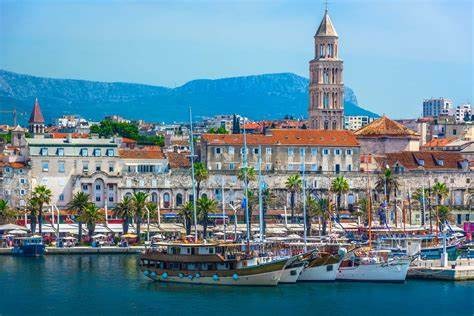
A UNESCO-listed Roman imperial residence from the 4th century, Diocletian's Palace forms the living heart of Split, in Dalmatia.
Diocletian's Palace occupies the historic centre of Split, on the Dalmatian coast. This fortified imperial residence, built in the early 4th century, ranks among the world's best-preserved Roman remains. At once a luxurious villa and military stronghold, the complex combined residential, administrative and defensive functions on a single site.
Why visit Diocletian's Palace
The palace is not a frozen archaeological site: it is a living neighbourhood of Split, continuously inhabited for seventeen centuries. Shops, cafés, homes and places of worship coexist within the ancient walls, making it one of the rare examples worldwide where you can move freely through still-functioning Roman imperial architecture. Inscribed on the UNESCO World Heritage list in 1979, the complex comprises fortified walls, peristyle, a mausoleum converted into a cathedral, a Roman temple, vaulted underground chambers and materials sourced from across the Empire.
History
Emperor Diocletian had this palace built near Salona (present-day Split) around 295. To construct his future residence, he had precious materials shipped from across the Empire: marble from Italy, columns and sphinxes from Egypt, stone from the island of Brač.
The palatial complex spanned 40,000 m² and combined a luxurious villa with a military camp, divided into four sections by two main streets crossing at right angles. On June 1st, 305, the emperor entered through the Golden Gate to spend his final years here, after abdicating in Nicomedia.
The site's function changed after the Empire's fall. The population of Salona took refuge here in the 7th century during Slavic invasions. Diocletian's mausoleum was converted into Saint Domnius Cathedral in 650, and a medieval town gradually developed inside and around the walls. The entire complex was inscribed on the UNESCO World Heritage list in 1979.
What to see on site
The four gates
Four monumental entrances punctuate the fortifications, each oriented toward a cardinal point.
- The Golden Gate (Porta septemtrionalis): on the north wall, it is the most ornate. Rectangular in plan at 9 by 9 metres, it features an interior courtyard with double doors, characteristic of Roman military fortifications. The statue of Bishop Gregory of Nin stands before the entrance; local tradition holds that touching his toe brings good fortune.
- The Bronze Gate (Porta Meridionalis): the southern entrance providing maritime access from the Adriatic. Ships could dock directly to unload goods into the vaults. Today it is the main access to the heart of the palace from the Riva.
- The Silver Gate (Porta Orientalis): facing east, it marks the beginning of the decumanus. Closed from the Middle Ages until 1952, it was rebuilt after the demolition of the Baroque church of the Innocents. Pope John Paul II passed through it during his visit in 2000.
- The Iron Gate (Porta Occidentalis): the only one of the four to have maintained uninterrupted urban activity for 17 centuries. A Renaissance bell tower surmounts it, fitted with a clock face bearing 24 Roman numerals.
The peristyle
The palace's central plaza, the peristyle is bordered by columns of red granite from Egypt. It served as the setting for the emperor's public appearances. Near the entrance to Saint Domnius Cathedral stands a thousand-year-old Egyptian sphinx, testament to the links between ancient Rome and Egypt.
The vestibule
A circular hall with an open-air dome, the vestibule served as an anteroom to the imperial apartments. Its acoustics make it a favoured venue for traditional Dalmatian choirs (klapa). To the south-east of the vestibule stands the oldest pre-Romanesque dwelling in Split, dating from the 10th century.
The Temple of Jupiter
The temple rests on an elevated podium preceded by a portico with six columns. Its coffered ceiling is sculpted with Roman masks and rosettes. Transformed into a baptistry in the 7th century, it houses a bronze statue of Saint John the Baptist by Ivan Meštrović. A black granite Egyptian sphinx, attributed to the era of Thutmosis III, guards its entrance.
The underground vaults
The vaulted underground chambers extend over the same area as the former imperial apartments. Originally designed to elevate the residential quarters and offer them views of the Adriatic, they rank among the world's best-preserved ancient Roman structures — one of the principal reasons for UNESCO listing. The ceilings rise to over 8 metres, supported by thick columns and arches of local limestone. Archaeological remains are found here, including ancient oil presses and ceramic fragments.
Saint Domnius Cathedral
Built on the site of Diocletian's former mausoleum, the cathedral features octagonal architecture and a 57-metre Gothic bell tower added in the 13th century. Inside, the 13th-century Romanesque pulpit is carved from a single block of limestone. The building also preserves relics and medieval manuscripts.
Practical information
The palace's perimeter is freely accessible year-round: you move through the streets as in any Split neighbourhood. Protected heritage spaces (vaults, cathedral, bell tower, Temple of Jupiter, treasure) require an admission fee, with moderate rates and combination tickets available on site. Allow 2 to 3 hours to explore the main accessible areas, longer if you climb the bell tower. Clothing covering shoulders and knees is required inside the cathedral.
When to visit
The palace is open year-round. High season (July-August) draws substantial crowds, particularly at midday cruise ship stops: favour early morning or late afternoon to photograph the peristyle without crowds. Spring (April-June) and early autumn (September-October) offer more comfortable conditions, with mild temperatures and favourable light. In summer, concerts and performances take place in the peristyle.
How to get there
The palace constitutes Split's historic centre and is easily reached on foot from the port and the Riva promenade. From the main bus and train stations, located side by side south-east of the old town, allow about ten minutes' walk. Several urban bus lines serve the market area (Tržnica stop), near the Silver Gate. By car, parking in the centre is difficult: prefer the harbour car parks or those on the old town's periphery, then complete your journey on foot.
Around the palace
After visiting the palace, extend your exploration throughout Dalmatia and beyond:
- Zlatni Rat beach at Bol, on the island of Brač, accessible by ferry from Split.
- Plitvice Lakes National Park, the country's largest national park.
- Lake Vrana Nature Park, a protected wetland in northern Dalmatia.
Frequently asked questions
Frequently asked questions
Include Split in your journey
Diocletian's Palace forms a natural stop on a Dalmatian itinerary, between Adriatic islands and inland national parks. To craft a custom itinerary, consult our Croatie holidays.
Interested in this visit?
We can include it in your personalised itinerary.