Krajina and Una National Park
The river-threaded northwest of Bosnie, structured by the Una and Vrbas rivers: whitewater rafting, travertine waterfalls, Ottoman towns and limestone canyons between Bihać and Banja Luka.
Krajina occupies the northwestern quarter of the country, wedged between the Croatian border to the north and the central highlands to the south. Our team regularly takes travelers here who seek a green, river-threaded Bosnie—less urban than Sarajevo and less Mediterranean than Herzegovina. The region's heartbeat follows two rivers: the Una, which lends its name to the national park established in 2008, and the Vrbas, which carves a deep canyon around Banja Luka, the country's second city.
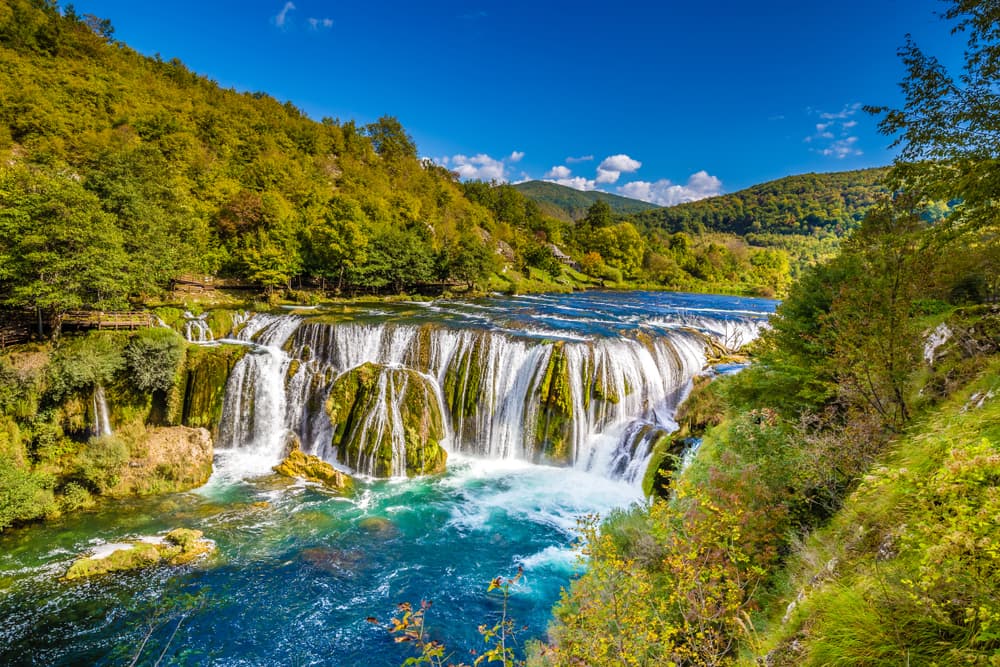
Una National Park protects 198 km² along the Croatian border, from the village of Martin Brod to the Lohovo gorges. Three sites concentrate the visitor's interest: Štrbački Buk falls, where water plunges 25 meters across multiple travertine tiers, the stepped cascades of Martin Brod, and the long navigable stretch between Kulen Vakuf and Bihać. The river remains raftable from April to October, with Class II and III passages suitable for families. For those seeking more technical whitewater, the Vrbas canyon downstream of Banja Luka offers Class IV sections and an equipped via ferrata across the limestone cliff face.
Bihać serves as the park's natural logistical base. The city grew around a meander of the Una and retains scattered Ottoman traces, including Kapetanova tower and the Fethija mosque, installed within a former Gothic church. Guesthouses line the riverbanks, often run by families who also rent canoes and bicycles. At table, Una trout arrives grilled or smoked, accompanied by potatoes and kajmak, the local fermented cream. In Banja Luka, the atmosphere is more urban: cafés on Krajina square, Kastel fortress overlooking the Vrbas, and a brewing heritage inherited from the Banjalučko Pivo brewery founded in 1873.
Krajina carries a dense and sometimes heavy history. The region was an active front during the 1992–1995 war, and some villages still bear the conflict's marks. Jajce, at the region's southern edge, deserves a half-day stop: this fortified medieval town crowned Bosnian kings in the 15th century, and its 22-meter waterfall drops directly through the center, at the confluence of the Pliva and Vrbas. The Pliva lakes just upstream shelter some twenty small wooden watermills still standing, relics of a rural economy slowly fading away.
Settlement is mixed, with Bosniak predominance around Bihać and Serb predominance around Banja Luka, a legacy of post-Dayton organization dividing Bosnie into two entities. This duality reads across the cities: minarets and mosques on one side, Orthodox churches and Cyrillic signage on the other. The economy rests on timber processing, plateau agriculture, and growing nature tourism still far from saturation. You'll encounter more fly fishermen and local kayakers than tour buses.
The climate is temperate continental, more humid than the country's south. Summers hover around 26 to 28°C in daytime, cool noticeably in evening thanks to the rivers, and winters regularly dip below zero with snow possible on surrounding ridges. This is a region where water structures everything: tourism, cuisine, village rhythms, and landscapes from every vantage point.
To discover
Štrbački Buk falls on the Una. Wooden viewing platform overhanging a 25-meter travertine cascade, 20 km south of Bihać. The water takes on the characteristic turquoise hue of karst rivers.
Una River rafting descent. 15 km run between Kulen Vakuf and Lohovo, crossing the national park. Class II and III, navigable April through October, guided by local Bihać clubs.
Jajce and the Pliva mills. Medieval town featuring a 22-meter urban waterfall, complemented 5 km upstream by some twenty small wooden mills on the Pliva lakes.
Vrbas Canyon at Banja Luka. Class IV rafting downstream from Krupa power station, Tijesno via ferrata equipped over 350 meters in limestone walls. Water sports base 15 minutes from downtown.
Ostrožac Fortress. Austro-Hungarian castle reworked on medieval foundations, dominating the Una valley north of Cazin. Contemporary sculpture park in the moat, rarely crowded.
When to go
The viable season extends April through October. May and June are our preferred months for Una Park: the river runs high after snowmelt, waterfalls flow at full force, banks are verdant and temperatures range between 18 and 24°C. July and August climb to 27–30°C in daytime, making swimming and rafting particularly pleasant, but Bihać fills with weekend visitors from Croatia and Slovenia. September strikes a good balance: water still pleasantly warm, light soft, visitor numbers declining.
From November to March, the region enters tourist dormancy. Rain is frequent in November and March, and winter temperatures drop between –2 and 5°C, with snow possible on plateaus around Bosanski Petrovac. Rafting operators close, park guesthouses operate at reduced capacity. Only Banja Luka remains fully active year-round due to its urban role.
Practical advice
We recommend a minimum of 3 nights for the region, ideally 4. One night in Banja Luka for the Vrbas and the city, two nights in Bihać or a park guesthouse to explore the Una by raft and foot, and one night in Jajce, which fits naturally along the route toward central Bosnie. Access comes either from Sarajevo airport (4.5 hours' drive to Bihać via Jajce) or from Zagreb in Croatia (2 hours to Bihać), an option we often favor for combined Croatia-Bosnie itineraries.
Krajina links logically with central Bosnie (Travnik, with Jajce serving as transition) and then Sarajevo. Descending it from the north and moving into Herzegovina thereafter makes for a coherent 12–14 day itinerary. Accommodation comfort is respectable without luxury: family guesthouses and 3-star hotels, a few riverside properties with character. The region suits active families particularly well, whitewater enthusiasts, fly fishermen, and travelers who prefer nature to museums.