Baščaršija
Baščaršija
Ottoman bazaar founded in 1462, Baščaršija is the historic heart of Sarajevo: 16th-century mosques, neo-Moorish city hall and Latin Bridge.
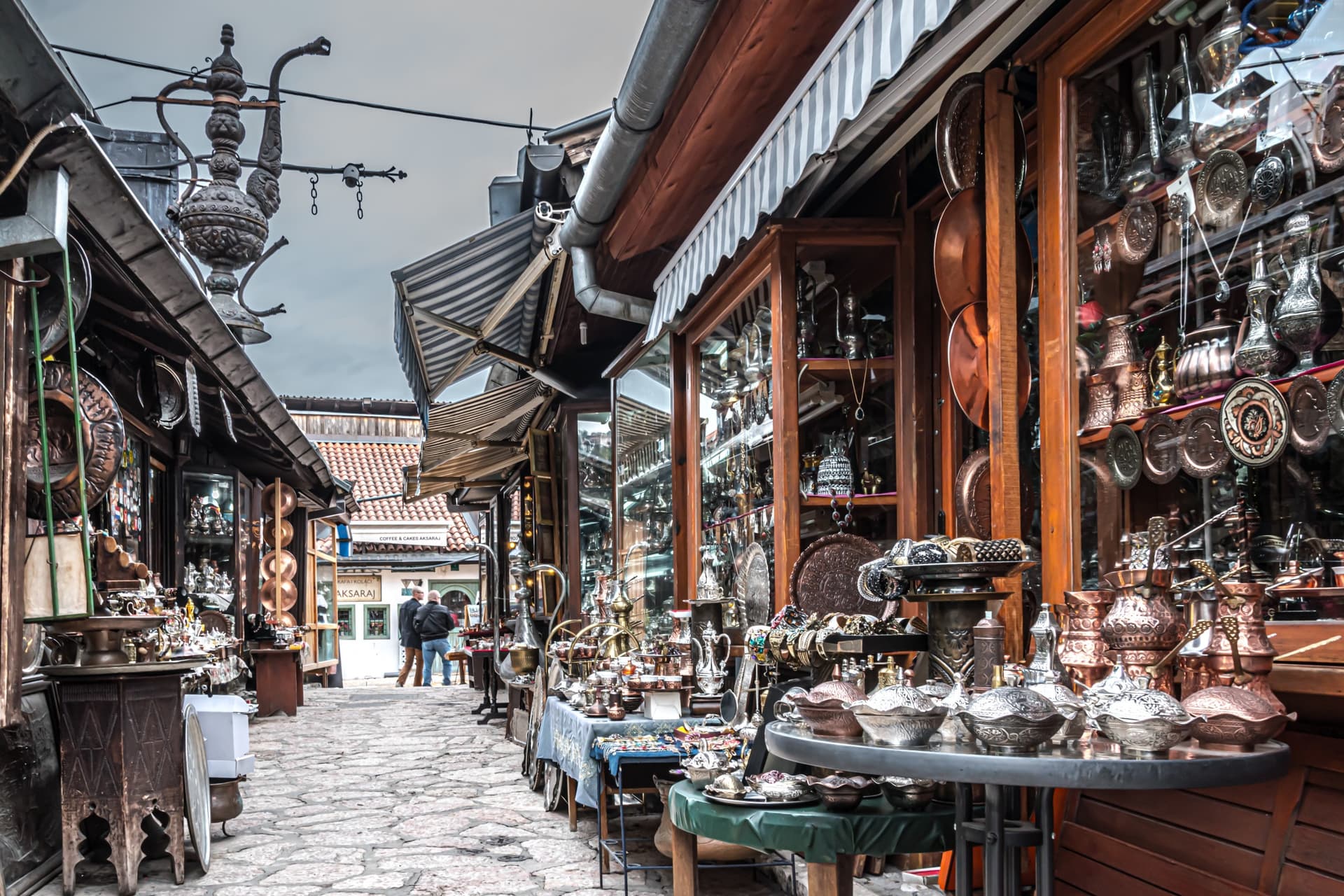
Baščaršija refers both to Sarajevo's historic bazaar and the neighbourhood surrounding it. The Ottoman heart of Bosnia and Herzegovina's capital, this pedestrian district brings together 16th-century mosques, fountains, artisans' workshops and sites of memory in remarkable density. A few hours of walking are enough to traverse five centuries of Balkan history.
Why visit Baščaršija
Baščaršija is the historic and cultural centre of Sarajevo, in Bosnia and Herzegovina. The neighbourhood contains within a few hectares the city's main Ottoman buildings, one of the oldest mosques in the Balkans, a 16th-century Sephardic synagogue, an Orthodox church mentioned as early as 1539, and a bridge that became famous for an assassination that triggered World War I. It is also a living neighbourhood, where copperwork, leathercraft and embroidery continue to occupy the alleyways. Bosnian coffee, burek and ćevapi are savoured in family-run taverns that line the paved squares.
Ferhadija Street marks the transition between the modern Austro-Hungarian city and the Ottoman heart: crossing this line means moving within metres from Viennese architecture to the alleyways of a bazaar.
History of the neighbourhood
Baščaršija was born in 1462 as a han (caravanserai) founded by Ottoman governor Isa-Beg Ishaković. The name derives from Turkish and means "at the main bazaar". Around this commercial waystation, neighbourhoods of specialized artisans developed: Bazerdžani (merchants), Kazaz (passementerie makers), Sedlar (saddlers) and Sarača (harness makers).
In the 16th century, Sarajevo became a major crossroads of the Balkans. The Gazi Husrev-beg Mosque was erected in 1530, accompanied by a medresa, library, hammam and bezistan. Religious diversity was inscribed into the urban fabric: an Orthodox church is mentioned as early as 1539, and the first Sephardic synagogue was built between 1581 and 1587.
The neighbourhood suffered the attack of Prince Eugene of Savoy in 1697, which devastated much of the city. Austro-Hungarian occupation from 1878 onwards modernized Sarajevo according to European standards and caused the bazaar to lose its central commercial role. Despite demolition plans in the 20th century, Baščaršija was preserved and remains one of the best-conserved Ottoman ensembles in the region.
What to see in Baščaršija
The Sebilj Fountain
An iconic meeting point of the neighbourhood, the Sebilj, in its current form, dates from 1913. It is the last wooden fountain in the shape of a kiosk still standing in Sarajevo. The square surrounding it is known for its pigeons, fed daily by residents.
The Gazi Husrev-beg Mosque
Built in 1530, it is the oldest mosque in Bosnia and Herzegovina. The building, crowned with nine domes, can accommodate 1,500 worshippers. According to a locally held tradition widely repeated, it was allegedly the first mosque in the world to be electrified. Nearby, the bezistan (covered market), medresa and Gazi Husrev-begova library complete the waqf complex.
The City Hall (Vijećnica)
Completed in 1896 according to plans by architect Karel Pařík, the City Hall adopts a neo-Moorish style that contrasts with the surrounding Ottoman buildings. Destroyed during the Siege of Sarajevo, it has been restored and now houses the Ars Aevi Contemporary Art Museum. Its stained-glass ceiling deserves an interior visit.
The Latin Bridge
Built in stone at the end of the 18th century, this bridge spans the Miljacka at a location already documented in 1541. It was at its approaches that Archduke Franz Ferdinand and his wife were assassinated on 28 June 1914, an event that precipitated the entry into war of the great European powers. Just nearby, the Sarajevo Museum 1878–1918 retraces the Austro-Hungarian period.
The Sahat Kula
This 30-metre clock tower, dating from the era of Gazi Husrev-beg in the 16th century, is the tallest in Bosnia and Herzegovina. It still shows the time according to the lunar calculation used for prayers.
The Han Morića
Founded in 1551, it is the only surviving han in Sarajevo. The caravanserai could accommodate up to 300 travellers and 70 horses. On 29 July 1878, citizens of Sarajevo gathered here to form the Narodni Odbor (People's Council) which opposed Austro-Hungarian occupation. The building today houses a café, restaurant and several craft shops.
Practical information
- Access: Pedestrian neighbourhood open permanently, free access. Religious buildings and museums have their own opening hours.
- Visit: Allow 2 to 4 hours to tour the main sites on foot, half a day if you enter several museums.
- Dress code: Shoulders and knees covered to enter mosques; women can borrow a scarf at the entrance of Gazi Husrev-beg.
- Bargaining: Common in bazaar shops, but without excess.
- Specialities to taste: ćevapi (grilled meat balls served with somun bread), burek (meat pastry), Bosnian coffee served in a copper dezva.
How to get there
The tram serves the Baščaršija stop, just steps away from Sebilj Fountain: this is the simplest option from the railway station or other neighbourhoods of Sarajevo.
From Sarajevo Airport, the Centrotrans shuttle reaches the city centre in about thirty minutes for a modest fare. Official taxis are a practical alternative; ask the price before departure or insist on the meter.
On foot from the modern centre, follow the shopping street Ferhadija: it leads directly to the bazaar in about ten minutes.
Nearby
Sarajevo and neighbouring Bosnia and Herzegovina offer several complementary sites to extend your visit, such as the pyramids of Bosnia at Visoko, accessible as a day excursion. To compare the architectural heritage of the region, the Palace of Diocletian in Split and the Basilica of Euphrasius in Poreč illustrate the Roman and Byzantine layers of the Adriatic.
Frequently asked questions
Frequently asked questions
Baščaršija is located in the historic centre of Sarajevo, capital of Bosnia and Herzegovina. The neighbourhood extends around Sebilj Fountain, on the north bank of the Miljacka.
Allow 2 to 4 hours for a stroll through the bazaar and an exterior visit to the main monuments. A half day to a full day if you include museums and breaks in cafés.
Yes, outside prayer times, for a modest entry fee. Modest dress is required and a scarf is provided to visitors at the entrance.
Spring (April–June) and early autumn (September–October) offer pleasant weather and reasonable crowds. Summer remains warm but lively, winter snow-covered gives the bazaar a particular atmosphere.
No, Baščaršija is an open neighbourhood and free. Only certain interior visits (mosque, museums, city hall) are paid.
Prepare your trip
Baščaršija naturally integrates into a Balkan itinerary combining Bosnia and the Adriatic coast. To build a bespoke stay including Sarajevo and its surroundings, consult our trips to the region.
Interested in this visit?
We can include it in your personalised itinerary.