Šibenik
Šibenik
Šibenik, founded in the 11th century on the Dalmatian coast, brings together a Renaissance cathedral listed by UNESCO, Venetian fortresses, and direct access to Krka National Park.
Šibenik stretches along the Dalmatian coast between Split and Zadar, at the mouth of the Krka River. A medieval city founded by Croats in the 11th century — not by Roman colonists — it preserves a dense historic center, two Venetian fortresses, and a cathedral listed as a UNESCO World Heritage site. It's a solid base for exploring Krka National Park, just a few kilometers inland.
Quick Facts
- Access: central bus station with regular connections to Split, Zadar, and Zagreb; limited rail service.
- Recommended duration: a full day for the historic center; two days if combining with Krka National Park.
- Dress code: shoulders and knees covered to enter St. James Cathedral.
- Accessibility: the medieval center is very steep and paved; fortress access is difficult for wheelchair users.
What to See
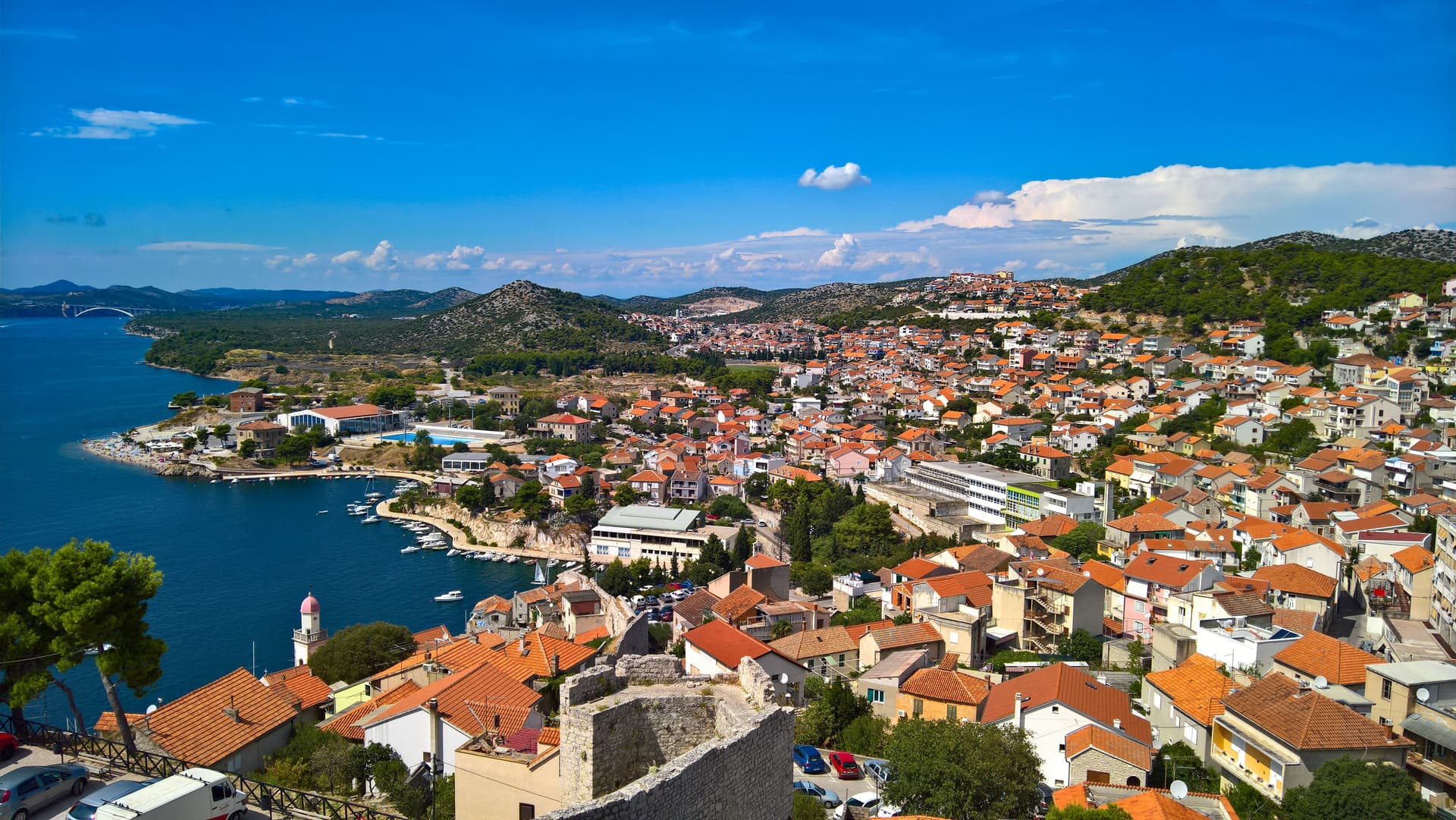
The heart of Šibenik is a maze of white limestone alleys climbing toward the fortresses. St. James Cathedral dominates the central square. Higher up, St. Michael's Fortress offers clear views over the bay and the Šibenik islands. St. John's Fortress and Šubićevac Fortress complete the Venetian defensive system. Along the waterfront, the promenade runs past cafés and fishing boats.
History and Context
Šibenik is the oldest city in Croatie founded by Slavs, first mentioned in 1066 in a document by King Petar Krešimir IV. Falling under Venetian rule in the 15th century, it was fortified against Ottoman raids. St. James Cathedral, built between 1431 and 1535, is a masterpiece of the Gothic-Renaissance transition and the principal work of architect Juraj Dalmatinac.
Highlights
St. James Cathedral
Listed by UNESCO in 2000, the cathedral stands out for its construction entirely in ashlar stone, without brick or wood. The frieze of 71 sculpted portraits around the outer edge of the apse represents contemporaries of Juraj Dalmatinac — a rare detail in medieval European architecture.
St. Michael's Fortress
Perched above the old town, St. Michael's Fortress has been restored and hosts open-air concerts in summer. The walk from Republic Square takes about fifteen minutes via paved steps. The view over Šibenik Bay and the Kornati islands in the distance is remarkable.
St. Nicholas Fortress
Located at the entrance to the Šibenik Channel, this 16th-century fortress is accessible only by boat. Listed by UNESCO in 2017 alongside the Venetian fortifications of the Adriatic, it sees fewer visitors than St. Michael's and deserves a detour for its intact military architecture.
Medieval Quarter and Republic Square
Republic of Croatie Square (formerly Cathedral Square) is the city's focal point. Gothic palaces, the municipal loggia, and the rector's palace frame the cathedral. In the evening, the terraces come alive without the atmosphere becoming overwhelming.
Etiquette and Visiting Rules
- Shoulders and knees must be covered to enter St. James Cathedral.
- The cathedral is an active place of worship: maintain silence and discretion during services.
- Photography is generally permitted inside, without flash.
Photography Tips
Morning light is ideal on the cathedral's west facade, before groups arrive. From St. Michael's Fortress, sunset over the bay and islands casts warm tones on the old town's white limestone. For St. Nicholas Fortress, plan a boat excursion mid-day when light strikes the walls directly.
Location and Access
Šibenik is located on the Dalmatian coast, about 80 km north of Split and 80 km south of Zadar. The bus station is just a short walk from the historic center. Local boats connect the waterfront to nearby islands and St. Nicholas Fortress. Krka National Park is accessible by bus or boat from Šibenik's port.
Nearby
- Krka National Park — terraced waterfalls on the Krka River, swimming permitted at certain times in designated zones.
- Kornati National Park — archipelago of 89 arid limestone islands, accessible by boat excursion from Šibenik or Murter.
- Primošten — peninsula village south of Šibenik, known for its terraced vineyards and old town on an islet.
- Trogir — UNESCO-listed medieval city about 40 km south, connected by regular bus service.
Frequently asked questions
May-June and September-October offer a good balance: moderate warmth and fewer crowds than July-August. Summer remains pleasant but the historic center can be very crowded.
Yes, if you start early. The park is accessible by bus or boat from Šibenik. Plan the morning at the park and the afternoon in the old town, or vice versa.
Only by boat from Šibenik's port. Organized excursions offer this trip, often combined with a bay tour.
With difficulty. The alleys are paved and very steep. The waterfront is more manageable, but access to the fortresses and cathedral remains challenging for wheelchair users.
Yes: shoulders and knees must be covered. Bring a light shawl or garment if visiting in summer.
Yes. Šibenik is less touristy than these two cities and offers a more local atmosphere. St. James Cathedral and proximity to Krka Park make it a distinct stop, not a duplicate.
Want to discover this destination?
Our local advisors design your tailor-made trip.