Rastoke
Rastoke
At the confluence of the Slunjčica and Korana rivers, Rastoke lines up 17th-century stone watermills and turquoise cascades. An ideal nature and heritage stop on the road to Plitvice Lakes.
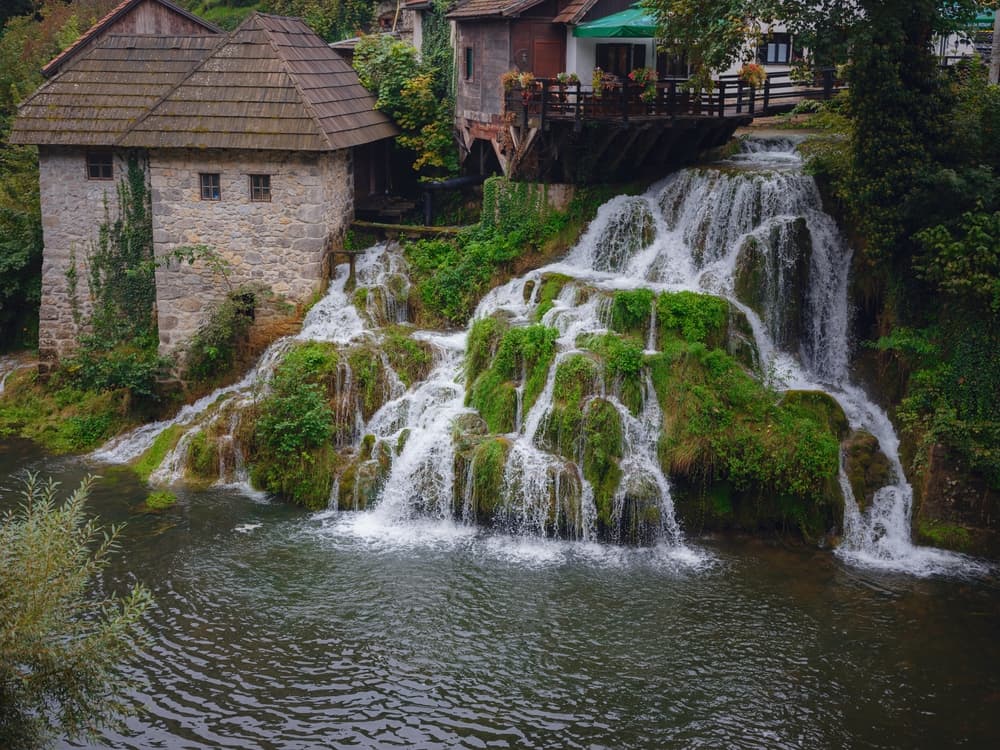
Rastoke is a hamlet of watermills nestled at the confluence of the Slunjčica and Korana rivers, at the edge of the town of Slunj, in the Lika region. The cascades tumbling between stone houses, the ancient mills still standing, and the turquoise pools make it a rare natural and ethnographic site, often nicknamed "Plitvice in miniature." A visit naturally combines with Plitvice Lakes National Park, about thirty kilometers away.
Quick practical info
- Entrance: paid access to the developed site (check rates locally or with the Slunj tourism office).
- Recommended duration: 1 to 2 hours to walk the wooden walkways and explore the mills.
- Access: by car from Zagreb (approximately 100 km) or from Plitvice (approximately 30 km); parking available at the village entrance.
- Attire: non-slip sole shoes recommended — wooden walkways can be slippery.
- Accessibility: limited; wooden walkways and stone staircases make wheelchairs difficult to navigate.
What to see
The Slunjčica divides into dozens of channels before joining the Korana, creating a network of cascades, limestone tufa formations, and small lakes. The watermills — some dating from the 17th century — are built directly on the rocks, with water flowing literally beneath the floorboards. Wooden walkways allow visitors to move between inhabited houses and waterfalls.
History and context
Rastoke developed from the 17th century onwards thanks to the hydraulic power of the Slunjčica. The mills were used to grind grain and saw wood for the entire region. During the wars of the 1990s, the village suffered significant damage; much of it has been reconstructed and restored since. Today, a few families still live here year-round, maintaining the mills and welcoming visitors.
Highlights of the visit
The watermills
Several mills are open to visitors. Inside, the wooden mechanisms — millstones, gears, water channels — are preserved or reconstructed. Some owners explain how they work during the tourist season.
The Slunjčica cascades
The river flows over a series of natural tufa barriers before plunging into the Korana. Water flow is most spectacular in spring, after snowmelt. In summer, the turquoise colour of the pools is particularly striking.
The viewpoint at the confluence
From the edge of the Korana, you can take in at a glance the mills suspended above the falls and the forested cliff in the background. This is the most photographed angle of the site.
Photography tips
Morning light (before 10 a.m.) avoids harsh shadows and unwanted reflections on the water. A polarizing filter enhances the turquoise colour of the pools. For long-exposure shots of the cascades, a lightweight tripod is useful; the walkways vibrate as other visitors pass, so it's best to wait for a quiet moment. The viewpoint from the bridge over the Korana offers the widest framing.
Location and access
Rastoke is located at the northern entrance to Slunj, in central Croatie. From Zagreb, allow approximately 1.5 hours by car via highway A1 and the national road. From Plitvice Lakes National Park, road D1 connects the two sites in approximately half an hour. There is no regular direct bus service to the hamlet; Zagreb–Split buses stop in Slunj, from where Rastoke is accessible on foot in a few minutes.
Nearby
- Plitvice Lakes National Park — the UNESCO site with sixteen cascading lakes, about thirty kilometers to the south.
- Old town of Slunj — medieval fortress and panoramic views of the Korana, a few minutes' walk away.
- Mrežnica River — waterfall river ideal for kayaking and swimming, about forty kilometers away.
Frequently asked questions
Spring (April–May) offers the strongest water flow and therefore the most impressive cascades. Summer is peak tourist season; arrive early in the morning to avoid crowds. In autumn, colourful vegetation frames the mills beautifully.
Yes, this is the classic itinerary. Spend 1 to 2 hours at Rastoke in the morning, then head to Plitvice for the afternoon. However, bear in mind that Plitvice requires a minimum of 4 to 5 hours for a full tour.
Photography is free in outdoor areas. Inside private mills, ask the owners for permission before photographing.
Wooden walkways and stone staircases require careful supervision with young children. Strollers are difficult to manoeuvre; a baby carrier is more practical.
Swimming in the pools within the developed site is generally prohibited to preserve the limestone tufa. Swimming areas exist on the Korana outside the tourist perimeter.
Interested in this visit?
We can include it in your personalised itinerary.