The Catacombs of Jajce
The Catacombs of Jajce
At Jajce, the catacombs form a medieval underground church carved into rock, a rare testament to the independent Bosnian Church.
Carved into living rock at the heart of Jajce, the catacombs form a medieval underground church whose origins trace back to the turn of the 14th and 15th centuries. Located at the confluence of the Pliva and Vrbas rivers, the city was the seat of Bosnia's last kingdom, and this limestone-carved sanctuary stands as one of its most singular testaments. The site, modest in scale, intrigues through its unfinished sculptures, its syncretic iconography, and its role as a refuge across the centuries.
Why visit the Jajce catacombs
- A rare example of the independent Bosnian Church, a medieval religious movement distinct from the Catholic and Orthodox churches.
- Architecture entirely carved from rock, with narthex, baptistery, nave, and choir connected by narrow passages.
- Unusual iconography blending a double cross, sun, and crescent moon on the main altar.
- A site designated a national monument of Bosnia and Herzegovina since January 2003.
- A brief yet rich visit, worth combining with other curiosities of Jajce.
History of the catacombs
The earliest written sources mentioning Jajce date back to 1396. They cite Hrvoje Vukčić Hrvatinić, prince of the city, bearing the Latin title of "count of Jajcze." During his reign, at the turn of the 14th and 15th centuries, the city experienced marked political and cultural development. It was during this period that the catacombs were likely carved, intended to become the tomb of the prince and his family. The work was never completed, as evidenced by the interrupted sculptures still visible today.
The underground church originally stood outside Jajce's fortifications. It was incorporated into the urban enclosure following the second and third phases of fortification in the 15th century. In the 19th century, it served as a refuge for women and children during the Ottoman conquest led by Omer Pacha Latas. Local tradition also recounts that Tito hid here in 1943, during the second session of the AVNOJ held in Jajce—an episode often evoked on site, best understood as a locally transmitted narrative rather than a fully documented historical fact.
Since January 2003, the site has been designated a national monument by the Bosnian government.
What you'll see on site
The catacombs are oriented south-north, with the entrance at the southern end. The entire complex comprises four main spaces connected by narrow passages: a narthex, a baptistery, a nave, and a choir.
The entrance hall
The visitor first enters a small chamber where unfinished sculptures appear: heraldic symbols and the silhouette of a knight, testaments to the interrupted iconographic program.
The baptistery
Accessible through a narrow opening, it houses baptismal fonts as well as a seat carved into the stone.
The nave
The central space of the church, it preserves funeral vaults in its floor. The altar, carved directly from rock, is adorned with a double cross accompanied by a sun and crescent moon, motifs characteristic of medieval Bosnian religious art.
The choir
Located at the back, it is crowned by a pointed arch. On either side of the altar, spaces have been carved that may have been intended to house additional funeral vaults.
The filtered lighting and raw stone give the place a contemplative atmosphere, suited for visitors interested in religious archaeology and the medieval history of the Balkans.
Practical information
- Duration of visit: allow 30 to 45 minutes, as the site is compact.
- Admission: entry at modest cost (a few convertible marks), discounted rates for children and students.
- Local guide: guided tours available for an additional fee, recommended to grasp the iconographic context.
- Clothing: the temperature remains cool year-round inside; bring a warm layer even in summer.
- Accessibility: narrow passages and steps carved into rock, poorly suited for people with reduced mobility.
When to visit
The site is open year-round, with extended hours during peak season (morning through evening) and mid-afternoon closures during winter months. Spring and autumn offer the most pleasant conditions for walking around Jajce: mild temperatures and moderate crowds. Summer allows you to combine the visit with swimming in the Pliva lakes and observing the waterfalls in the city center. In winter, verify reduced hours before making the trip.
How to get there
Jajce is located in central Bosnia and Herzegovina, approximately two hours' drive from Sarajevo and three hours from Banja Luka. From Croatie, access is via Zagreb then Banja Luka, or via the Dalmatian coast through Split and then Livno. Daily buses connect Jajce to the main Bosnian cities. The catacombs are located in the historic center, a few minutes' walk from the fortress and waterfalls, marked from the main street.
Nearby
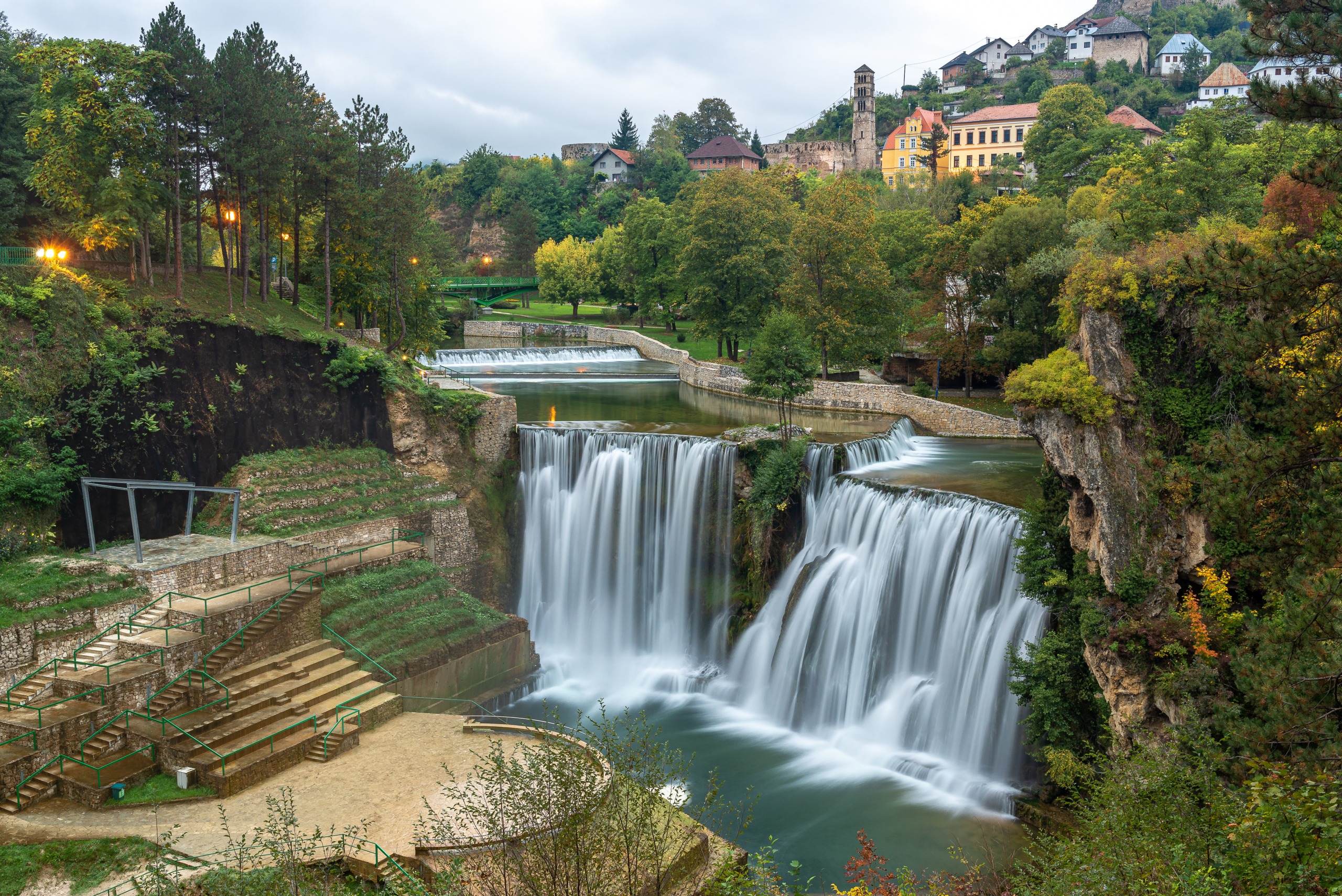
Jajce concentrates several remarkable sites within a small perimeter: the Pliva urban waterfall (one of the rare waterfalls in the heart of a European city), the medieval fortress that dominates the city, the Roman mithraeum, and the wooden mills of the Pliva lakes. To extend your exploration of the Balkans, you can turn to the pyramids of Bosnia near Visoko, the subject of lively archaeological debate. On the Croatie side, the Palace of Diocletian in Split and the hermitage of Blaca on the island of Brač complete an itinerary blending ancient heritage and spiritual retreat sites.
Frequently asked questions
Frequently asked questions
They are located in the historic center of Jajce, Bosnia and Herzegovina, at the confluence of the Pliva and Vrbas rivers. The entrance is marked from the main street, near the fortress.
Since the site is compact, 30 to 45 minutes are sufficient to explore all the spaces. With a guide, allow approximately one hour.
Local tradition recounts that he hid here in 1943, during the second session of the AVNOJ held in Jajce. It is a narrative transmitted on site rather than a fully documented historical fact.
Yes: the interior temperature is cool year-round, bring a jacket. The narrow passages and uneven floors make closed-toe shoes preferable.
Yes, but with reduced opening hours compared to peak season. Check locally before your visit.
Include Jajce in your trip
The Jajce catacombs fit naturally into a tour through the Balkans combining Bosnia and Herzegovina and Croatie. To build a custom itinerary blending medieval heritage, natural sites, and coastal cities, consult our suggestions for travel in Croatie and beyond.
Interested in this visit?
We can include it in your personalised itinerary.